

Ink & Aether Studios
2 days ago


Jade Black
5 days ago


Ink & Aether Studios
7 days ago

On rereading a beloved series, craft study done right, and why you don't actually want to write like your favorite author
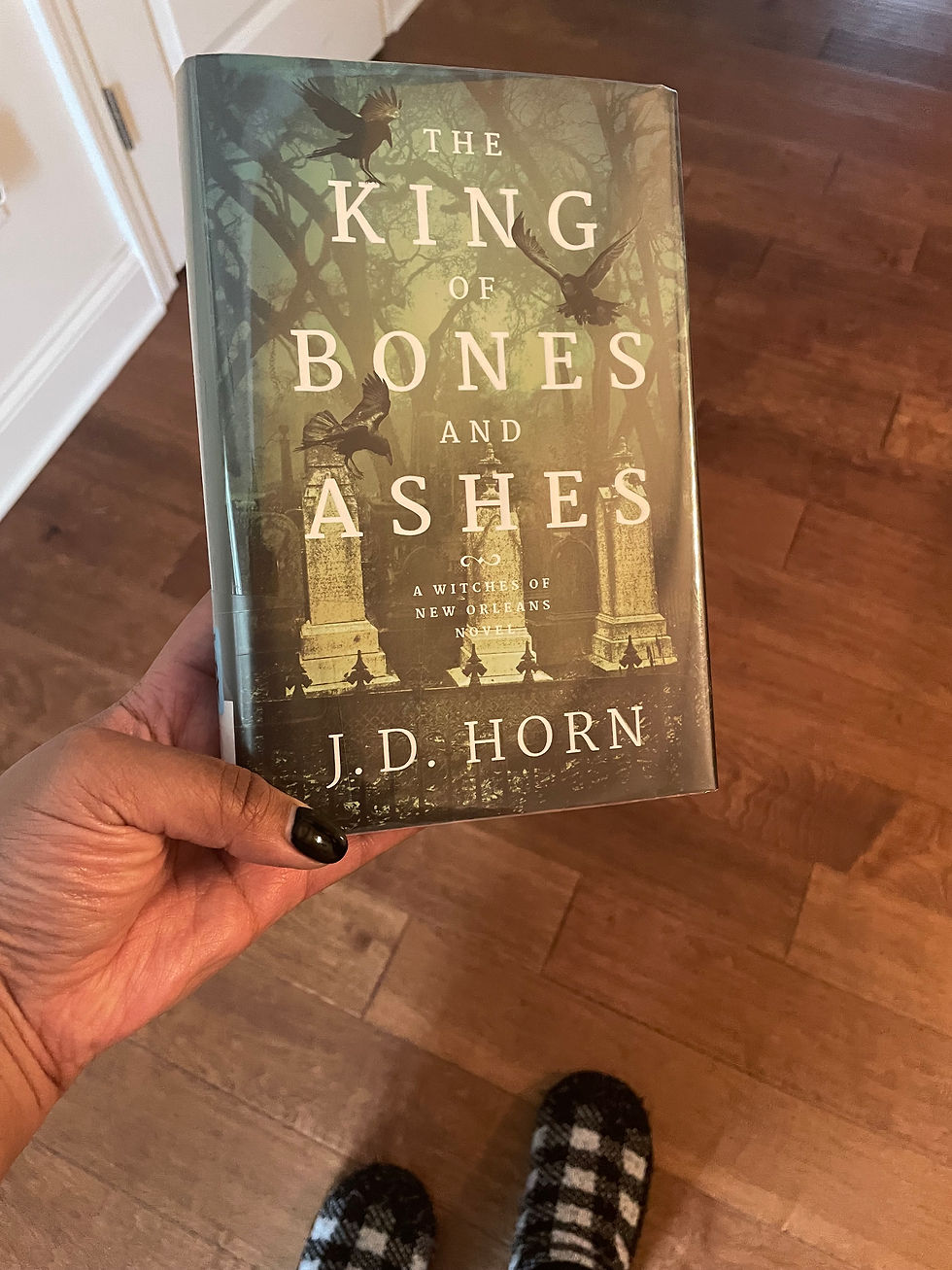
I've been rereading J.D. Horn's Witches of New Orleans series.
This is worth noting because I have not made time to read — genuinely, slowly, for myself — in about a year. The writing swallowed the reading, which is an occupational hazard nobody warns you about with quite enough urgency. You start writing seriously and suddenly every spare hour is a manuscript, a revision note, a research rabbit hole. The reading — the thing that made you want to write in the first place — gets quietly moved to the back burner.
And then something calls you back.
That's the part I've been sitting with: the call. I put this series down five years ago and I came back to it now, mid-launch prep, mid-revision season, mid-approximately-too-many-things — which means it wanted my attention badly enough to get it. That's interesting to me. Worth examining. Not just "oh I enjoyed this series" but: why this, why now, what is it doing that made it worth returning to?
That question is the beginning of actual craft study. And it's very different from what most "write like [author]" content is actually teaching.
Can we talk about that for a moment?
The "how to write like Emily Henry" or "how to write like Stephen King" genre of writing advice — and it is a genre at this point, with its own reliable conventions — is almost always doing something specific: it's breaking down surface features. Sentence length. Word choice. Structural beats. POV distance. The visible parts of the author's technique, extracted and presented as a recipe.
Follow these steps, the implication goes, and you can approximate the effect.
I understand the appeal. I do. When a book gets inside you in a particular way, of course you want to understand the mechanism. Of course you reach for the closest available explanation.
But here's what I've found, both as a reader and a writer: the surface features are not the source. They're the result. What made J.D. Horn's series pull me back across five years isn't the sentence construction — it's something underneath it. A relationship to place that feels inhabited rather than described. A particular way of letting characters carry knowledge the reader is still catching up to. An atmosphere that isn't manufactured through gothic adjectives but built slowly through accumulation and restraint.
Those are not things you can replicate by studying the sentences. They're things you have to feel your way toward by asking different questions.
So here's how I'm actually doing this craft study, if it's useful:
I'm reading for feeling before technique. When something works on me — when I slow down, when a scene sticks — I stop and ask: what just happened to me as a reader? Not what did the author do. What did I experience? That gap between effect and technique is where the real learning is.
I'm reading for what I notice on the second time through. The first read is for the story. The second is for the construction. What I missed the first time — what worked without my awareness — is almost always the most instructive thing.
I'm reading to understand my own responses, not to copy hers. The goal of craft study, for me, is not to produce J.D. Horn sentences. It's to understand what I respond to as a reader deeply enough to do something adjacent in my own work. In my own voice. Toward my own effects.
You don't want to write like your favorite author. You want to understand why they move you, and then figure out how you move people. That's the work.
The series is wonderful, by the way. If you haven't read it and you love atmospheric Southern fiction with magic woven into the marrow of place — go find it. Don't study it. Just read it first.
— J.P. 🗝️
Want updates from ALL my worlds?
Join The Inkbound Circle and get monthly dispatches from across genres—behind-the-scenes chaos, works-in-progress reveals, exclusive bonus stories, pen name updates, and the occasional confession from a writer fueled by spite, caffeine, and pure delusion that this will all work out fine.
No spam. No nonsense. Just magic.
Stories Across Realms


Comments