

Ink & Aether Studios
3 days ago


Ink & Aether Studios
6 days ago


Ink & Aether Studios
7 days ago

When the last of October bleeds into November in the Blue Ridge Mountains, the dark comes differently.

Not just earlier — though it does come early, the ridges cutting the light off at angles that don't make sense until you've lived with them for a season. It comes with a weight to it. The kind of weight that makes you check the window latch before you sit down to dinner. The kind that makes you leave a candle burning in the room where the old photograph sits.
The mountains are old. Older than most people reckon. The Appalachians are among the most ancient mountain ranges on earth, and they have been collecting the dead far longer than any of the traditions that eventually landed here. When the Scots-Irish settlers arrived in the Blue Ridge and the Smokies in the 18th century, carrying their Samhain customs from across the Atlantic, they weren't bringing these ideas to empty ground. The Cherokee were already here. The land had already developed its own ideas about what October 31st meant. What met in those mountains wasn't a dilution of one tradition by another — it was a layering. A conversation between cosmologies, held quietly over generations, that produced one of the richest and most genuinely strange bodies of folk belief in the American landscape.
Here is what was being carried, and what was already waiting.
It was the Scots-Irish who carried Samhain to America — bringing with them a Gaelic tradition that had already been transmuted by centuries of Christian overlay and Presbyterian suspicion of its own roots. Storytelling is a hallmark of that tradition, and those tales of Samhain merged with the Cherokee legends already present in these sacred mountains, producing something that couldn't have grown anywhere else.
The core of what they carried was this: Samhain was a harvest festival, marking the final harvest of the year and the beginning of winter's onset. People believed it was the night when the souls of their dead ancestors were set free to roam, and they might come into their houses and eat at their tables.
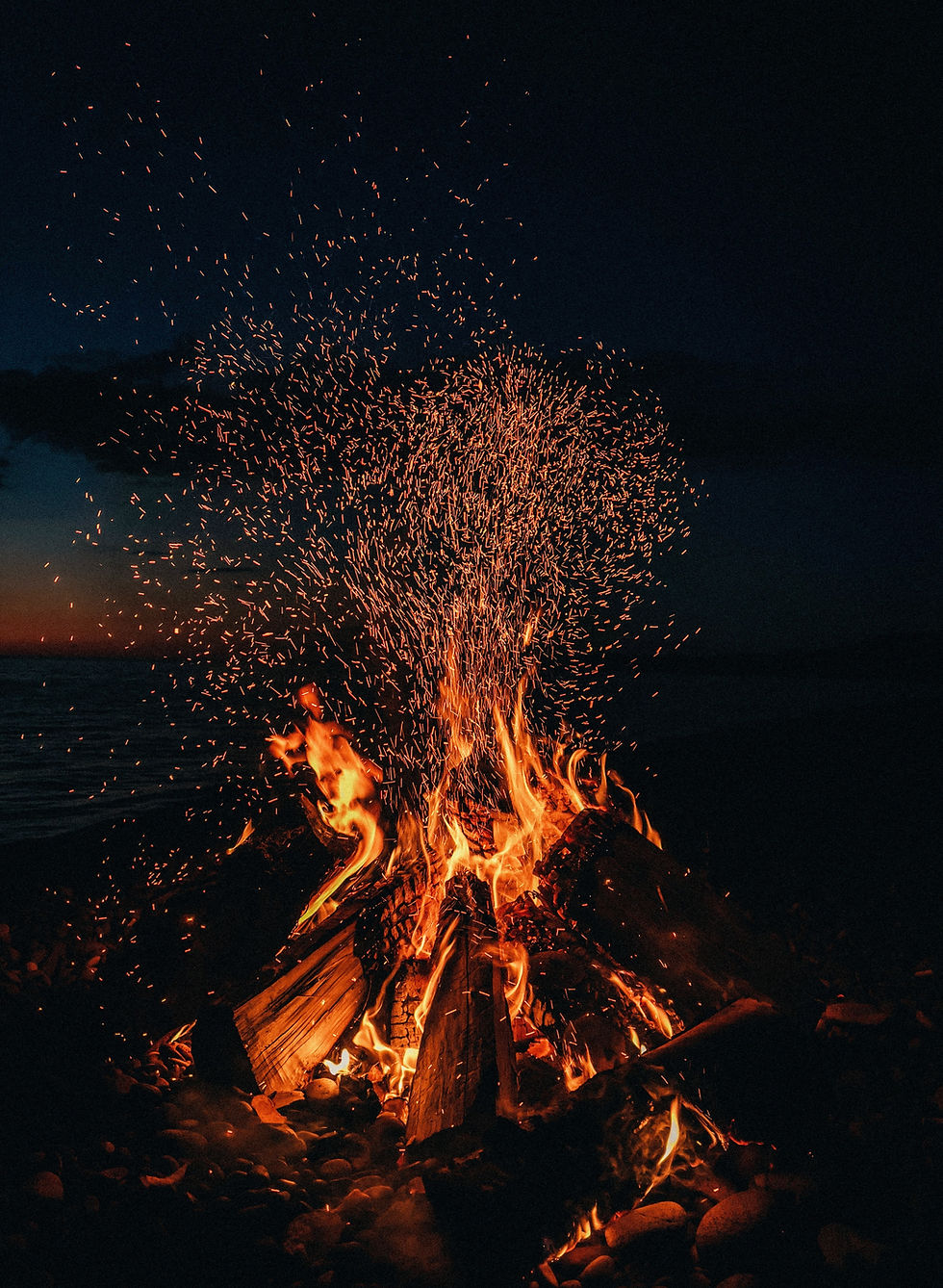
Bonfires — samhnagan in Gaelic — were lit as a form of protection from evil spirits lurking on that night. The fire was meant to repel those with ill intentions and hold them at bay until the sun rose again. In mountain communities, where the nearest neighbor might be several ridges over and the dark between the trees ran absolute, the fire had a meaning it couldn't quite hold in a city. It was not atmosphere. It was the only thing standing between the living and whatever was moving through the woods in the hours before dawn.
The hearth customs were specific and serious. Fires in the home would be left to die out on the first day of Samhain celebrations. Fresh fires were then laid in the hearth, ready to be lit when deemed safe. A cold hearth on Samhain Eve was not an oversight. It was a deliberate emptying — making space for the new fire that would carry the household through the dark half of the year.
The divination games that mountain communities held came directly from this inheritance. Each person would place a nut on the fire: if the nuts hissed it would be turbulent, but if they quietly and evenly burned it was a good match. Names were spoken over hazelnuts placed in coals. Apples were peeled in single long ribbons and thrown over the shoulder to form a letter. She could then divine her future husband by chanting: "If you love me, pop and fly; if you hate me, burn and die."
These were not children's games dressed up as superstition. They were the edge cases of a theology that understood October 31st as the hinge point of the year — the place where the door stood open, where what you asked for might actually receive an answer.

Of all the Samhain traditions the Scots-Irish carried into the Blue Ridge, the one that took deepest root — and is still observed in some communities today — is the dumb supper.
An Appalachian tradition of eating the Halloween dinner in complete silence, sometimes in reverse order with dessert first, with a place set for the departed. Dumb suppers here continue, and they are no joke.
Dumb here means silent, in the older usage of the word. The meal is prepared without speaking. Served without speaking. Eaten without speaking. The idea is that silence opens a door that noise keeps shut — that the ancestors invited to the table can only be heard when the living stop filling the air with their own sounds.
The meal is prepared in complete silence, no talking whatsoever, and most people believed that you had to walk backwards while cooking and serving. The backward movement through the kitchen is deliberate: you are working against the grain of ordinary time, the direction the living move through the world. To set a table for the dead requires moving like the dead move — not forward.
The empty chair at the dumb supper table is the hinge point of the whole thing. Whoever sits in it, in whatever form they come, was meant to come.
The Cherokee people had lived in the southern Appalachians long before the Scots-Irish arrived, and they had developed a body of supernatural knowledge deeply specific to these ridges and hollows and the things that moved through them.
Two figures above all others deserve their full names.
The Raven Mocker — Kâ'lanû Ahkyeli'skï — is, as James Mooney recorded in his foundational Myths of the Cherokee in 1900, the most feared of Cherokee witches. It robs the sick and dying of their heart. The sound of a raven mocker means that someone in the area will soon die. Medicine men will sometimes stand guard over the dying to prevent raven mockers from stealing the heart of the afflicted.
At night, when someone is sick or dying in the settlement, the Raven Mocker goes to that place to take their life. Every little while as it flies it makes a cry like the cry of a raven when it dives in the air — not the common raven cry — and those who hear it are afraid.
The Raven Mocker's central symbolism revolves around death, vulnerability, and the violation of the natural boundary between life and death. It targets someone already weakened by illness or approaching death. Once at the home of a dying person, the Raven Mocker becomes invisible.
The Raven Mocker is not a monster in the way the word is usually used. It is a witch — a being that was once human, or contains what was once human — and it adds the stolen life-years of its victims to its own. Only one who has the right medicine can recognize a Raven Mocker, and if such a person stays in the room with the sick, these witches are afraid to come in and retreat as soon as they see the medicine man, because when one of them is recognized in its right shape it must die within seven days.
Recognition is the weapon. Naming a thing correctly, seeing it for what it is — that is the theological claim at the center of this tradition, not a folk story. And in the mountains of western North Carolina, it has been passed down through community memory since before written record.

The Wampus Cat is a different order of creature. Within Cherokee folklore, there are reportedly two different versions of how the Wampus cat came to be. In one, a woman was equipped with a booger mask that held the spirit of a mountain cat. In another, a Cherokee woman spied on a sacred ceremony by hiding underneath the pelt of a mountain lion.
This tale became the foundation for Appalachian folklore, which holds that the Wampus cat was a woman punished for her disobedience or involvement in witchcraft. Other Appalachian folklore, likely influenced by European mythology, introduces the Wampus cat as a witch or woman with shape-shifting abilities.
The Wampus Cat is not European werewolf lore grafted onto Native tradition. She predates that graft entirely, and she carries a different weight. She is what happens when a woman crosses a boundary she was told not to cross — not as punishment, exactly, but as transformation. She is still running through the ridges.
In the Appalachian Mountains, stretching from West Virginia to Mississippi, folk magic goes by many names: root work, granny magic, kitchen witchery, Braucherei, witchcraft.
The granny witch — sometimes called the granny woman — was the practical theologian of the mountain community. The Granny Woman tradition eventually incorporated beliefs and practices from Native Americans, German immigrants, and African Americans in the rural southeastern mountains, resulting in a unique American hybrid folk tradition. These individuals became acknowledged sources of spiritual power in their roles as midwife, healer, and magical practitioner.
The Appalachian Granny Magic tradition was blended from Scots-Irish belief with a measure of local Cherokee tradition — a recipe that simmered on a low boil for many generations before anyone gave it a name.
What the granny witch held, in practice, was the space between the Cherokee understanding of spirits and the Scots-Irish understanding of the dead. She knew what to do when a raven called wrong outside a sick person's window. She knew what herbs to cut and when. She knew the dumb supper was not theater. She stood guard at the bed of the dying in the way the Cherokee medicine man stood guard — not because she had read the same texts, but because the mountains had taught both traditions the same thing: that the dying are vulnerable, that the threshold must be watched, and that watching it requires someone willing to stand at the boundary themselves.
Music is a large part of the tradition. Many of the oldest spells are sung and danced. The knowledge lives in the body as much as the mind. It was passed orally, practiced quietly, and frequently mistaken — by outsiders — for simple superstition.
It was not superstition. It was a survival theology developed by people who needed it.
One note that Appalachian folklore corrects about mainstream horror mythology: in genuine American folk tradition, silver bullets were not primarily for werewolves.
The silver bullet in American folk tradition was far more strongly associated with witches and shape-changers than with werewolves — the werewolf connection is largely a 20th-century pop-culture retrofitting. In Appalachian lore, a witch was one who had sold her soul to the devil, and though she might do good things with herbs, she was understood to be malevolent. A werewolf, when wounded, would carry the same wound in its human form. But the silver bullet's primary purpose was to reach something that ordinary lead could not touch — the witch who had stepped outside the ordinary laws of the physical world.
This matters for readers and writers both, because it changes the entire moral architecture of the supernatural in these mountains. The thing you're defending against isn't always a monster. Sometimes it's a neighbor.
The Blue Ridge at night in late October is not a landscape that invites rationalism.
The Brown Mountain Lights of Burke County, North Carolina — documented by federal investigators, studied by scientists for over a century, visible from overlooks along Highway 181 — have never been satisfactorily explained. The Cherokee understood them before European settlement. They are documented in local oral tradition as the lights of a Cherokee woman searching the mountainside for her husband killed in battle. Scientists have offered magnetic anomaly, electrical discharge, and bioluminescence. None of the explanations has held.
The Appalachian Mountains are among the oldest mountain ranges on earth, and they have been collecting secrets for longer than human memory reaches. The ridgelines that rise above the valleys of western North Carolina are not passive geography. In the folk tradition of the communities that have lived under them for centuries, they watch back. Stories have been passed down of things that came down from the upper ridgeline in silence, standing at the edge of a fire and placing warnings directly into the minds of those nearby — without speaking a word.
Whether you read those accounts as folklore or as experience depends on where you're standing when you encounter them.
On Samhain Eve, the boundary is thinnest. A candle burning blue in the window is not decoration — in Appalachian tradition, it signals that a ghost is near. Leave it burning. Leave the chair at the dumb supper table empty. Make sure the fire is properly extinguished before the new one is laid.
The mountain will tell you what else you need to know, if you're quiet enough to hear it.
These are novels and story collections worth reading alongside this subject — chosen for the diversity of their authors and the seriousness with which they treat the source material.
Ghost Days: An Anna O'Brien Collection by Asher ElbeinEight stories unspooling the legend of Anna O'Brien, a one-legged Appalachian witch of Cherokee descent at the turn of the century — a conjure woman whose powers bloom as she combats an increasingly strange and dangerous assortment of beasts and spirits. The creatures that populate Anna's world come mostly from Cherokee mythology, which provides a surprising and refreshing change from typical European-influenced American fabulist fiction. Among the most specifically researched pieces of Appalachian supernatural fiction currently in print.
The Removed by Brandon Hobson (Cherokee Nation author, 2021)Hobson's novel follows a Cherokee family grieving the death of a son on the eve of the National Cherokee Holiday, each family member entering an otherworld or visionary state that parallels the Trail of Tears and the generational wound it left. The supernatural elements are rooted in Cherokee cosmology without apology or explanation. Hobson writes from inside the tradition, not around it.
Jackal by Erin E. Adams (2022)As a Black woman, protagonist Liz carries few fond memories of this predominantly white Appalachian community — and when Black girls begin disappearing from the woods with their hearts ripped out, the horror of the mountain is inseparable from the horror of what the community chooses not to see. Adams uses Appalachian folklore and forest horror to interrogate who the mountains protect and who they consume. It is gripping and it is not comfortable.
White Horse by Erika T. Wurth (Apache/Chickasaw/Cherokee author, 2022)Kari James is an urban Native woman in Denver, haunted by her mother's spirit and drawn into a mystery involving a bracelet with a dark history. Wurth's horror is Indigenous horror — it emerges from the grief of cultural erasure and the power of what could not be erased. Devastating and very good.
Smothermoss by Alisa Alering (2023)In 1980s Appalachia, sisters Sheila and Angie navigate a mountain that sighs, monsters made of ink, rabbits dead and alive, and ropes that won't come undone. Unsettling, propulsive, and wonderfully atmospheric, Alering opens the door to the hidden world — what is seen and unseen, what is real and what is haunted. Among the best American horror novels of the decade.
Beloved by Toni Morrison (1987)Set in the post-Civil War Ohio/Kentucky borderlands rather than the Blue Ridge, but foundational to understanding ancestral haunting in American literature from a Black perspective — the ancestor who cannot rest, the child who returns, the house that remembers what happened in it. Nothing written since has replaced it as the primary text for this subject.
The Woods All Black by Lee Murray (2023)Set in 1920 Appalachia, this historical horror novella explores reproductive justice, bodily autonomy, small-town dogmatism, and identity — with the local rumored witch as one of the few figures who can be trusted with the truth. Atmosphere thick enough to press against the skin.
Roots, Branches & Spirits: The Folkways & Witchery of Appalachia by H. Byron Ballard — the village witch of Asheville teaches the old ways and why they work, from dowsing to communicating with spirits; part cultural journey, part magical guide, one of North America's most grounded regional folk practice books
Backwoods Witchcraft: Conjure & Folk Magic from Appalachia by Jake Richards — family tradition written down from direct hereditary practice; the most specific account of what granny magic actually looked like in daily life
Myths of the Cherokee by James Mooney, Bureau of American Ethnology (1900) — available free at Project Gutenberg; the primary source for the Raven Mocker and dozens of other Cherokee spirit traditions, collected from living community members in western North Carolina in the 1880s and 1890s
Witches, Ghosts and Signs: Folklore of the Southern Appalachians by Patrick Gainer — a rich compilation of mountain witch and ghost lore; the academic primary source for the witch tradition specifically
The Foxfire Book Series — oral history collected from Appalachian communities across decades; the raw primary sources, in community members' own words, unmediated
Stories Across Realms


Comments