

Ink & Aether Studios
17 hours ago


Ink & Aether Studios
3 days ago


Jade Black
6 days ago

Or: how a book gets built from the inside out
People ask writers where their stories come from and the honest answer is almost always: everywhere, in pieces, over a long time. It's rarely one lightning bolt moment. It's more like collecting fragments — an image here, a question there, a feeling that won't stop tapping on your shoulder until you finally turn around and say fine, I'll write it.
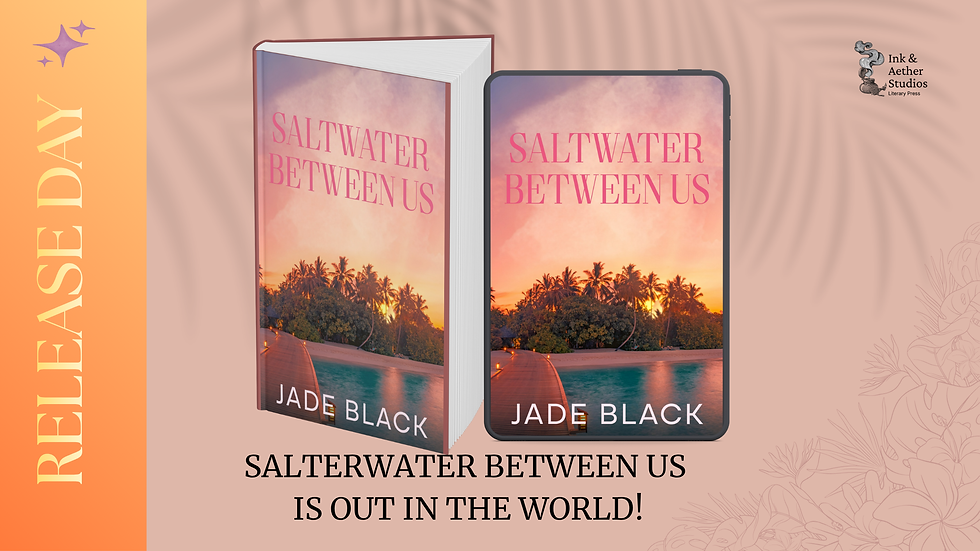
Saltwater Between Us was built from five particular fragments. Here's where they came from.
I became a little obsessed with solo sailing. Not in a "I'm personally going to learn to sail" way — though never say never — but in a what kind of person does this, and why way. Because solo sailing is not a casual undertaking. It requires technical knowledge, physical endurance, and a very specific relationship with solitude and risk. You are, quite literally, alone on the open water with the consequences of every decision you make.
That felt like the perfect external metaphor for what I wanted Cerys to be doing internally. She's not just sailing a boat. She's practicing the thing she's been afraid to do her whole life: trusting herself. Making the call. Living inside the consequence of her own choices without anyone else to blame or credit. The boat was always also her life. Sailing it was always also her becoming herself.
I spent a lot of time in forums and documentaries and trip logs from solo sailors — particularly women, particularly women of color, whose stories are criminally underrepresented in adventure narratives. They were extraordinary. They became part of Cerys's DNA.
The travel romance as a genre has given us so much joy. The vacation fling. The chance meeting in a foreign city. The love story that blooms because both people are slightly loosened from their ordinary lives, a little more open, a little more willing.
But I kept noticing something: in a lot of travel romances, the woman is the one who ends up staying. Or going home changed, while the place and the person she met there remain fixed. The travel is a backdrop to her transformation, but the destination is usually still love-as-anchor — love as the reason to stop moving.
I wanted to write a travel romance where the traveling is the point. Where the woman's journey doesn't end when she meets someone. Where the movement itself — the choosing to keep going — is part of the love story, not the obstacle to it. That felt new to me. That felt worth writing.
The islands of Te Motu Aroha are fictional, but they are built from real love and real research. French Polynesia — the culture, the landscape, the spiritual relationship between people and place and ocean — is extraordinary, and I took the responsibility of representing it seriously.
Liam's Taviani heritage isn't decoration. His cultural identity — the way it grounds him, the way it's been complicated by his immigrant parents' relationship to it, the way returning to the islands every summer feels like returning to oxygen — is central to who he is and what his arc is about. I wanted a hero whose connection to land and ancestry is spiritual and essential, not exotic. The islands themselves are not simply a pretty backdrop. They have weight. They have history. They ask things of the people who belong to them.
Getting that right mattered to me more than getting anything else right.
There is something that happens to people when they spend significant time on the open water. Sailors talk about it. Anyone who's spent a week on a boat and then stepped back onto land knows the slightly disorienting, clarifying feeling of re-entry — like your nervous system has been recalibrated.
The ocean strips away the noise. Not peacefully, always — sometimes loudly, sometimes terrifyingly. But it has this quality of insisting on presence. You cannot be on the open water and simultaneously be somewhere else in your head. It demands you. That felt important for Cerys's story: the ocean as the one place she couldn't people-please her way through, couldn't defer or hedge or shrink. The boat asked her to show up, and she had to.
I wanted readers to feel that quality — the aliveness of it, the demand of it — in every scene on the water.
This one is the most personal, so I'll be brief and honest about it.
"Choosing yourself" has become a phrase so overused it's almost lost its shape. It's on tote bags. It's in every self-help title. It's been sanded smooth.
But what it actually means in practice is specific and hard and not always pretty. It means disappointing people who have gotten used to a particular version of you. It means sitting with guilt that doesn't have a logical basis but has a very real physical weight. It means making the call you know is right and still second-guessing it for weeks. It means learning the difference between being practical and being afraid.
Cerys does all of this. She doesn't do it gracefully every time — she overthinks, she hesitates, she wakes up some mornings surprised this is her actual life. But she keeps going. She keeps choosing.
I wrote her because I believe that story is worth telling. Specifically, in this genre, with this heroine, right now — I believe it's worth telling.
The five fragments. The one book.
— Jade 🌊

Stories Across Realms




Comments